Road Pavement Research Group
INTRODUCTION TO THE RESEARCH GROUP
The Road Pavement Research Group (SZE Road Pavement) brings together research activities focusing on the scientific investigation of road infrastructure components and materials, as well as the development of sustainable and innovative road construction technologies. Its activities centre on a performance-based approach to pavement structures, modelling the rheological behaviour of construction materials, and applying modern non-destructive diagnostic methods at both network and local levels.
The research group places particular emphasis on life-cycle-based analysis of road networks, value-added recycling of reclaimed materials, and the integration of artificial intelligence and digital image processing into pavement condition assessment processes. The group aims to directly support the development of more durable, environmentally sustainable and cost-effective road infrastructure through both applied and theoretical research.
- Bitumen rheology and performance-based approaches: Performance-based binder analysis extending beyond the measurement of conventional properties. Key areas include the rheological characterisation of aged bitumen recovered from reclaimed asphalt pavement (RAP), as well as modelling the viscoelastic behaviour of blends prepared using various softening and rejuvenating agents.
- Classical asphalt mechanics and quality control: Investigation of the complex mechanical behaviour of asphalt mixtures across the full range of operating temperatures (low, intermediate and high temperature ranges). This includes asphalt mixture optimisation and the scientific evaluation of system-level quality control methods.
- Non-destructive diagnostics and network analysis: Detection and investigation of subsurface and surface structures, including the identification of utilities, voids and moisture-related problems. Pavement condition assessment at both local and network levels through comprehensive mathematical analysis of rut depth, longitudinal unevenness (IRI) and mean profile depth (MPD).
- Innovative methods and equipment development: Development of innovative technologies and mathematical models capable of replacing and modernising outdated infrastructure measurement procedures through the use of modern, faster and more accurate measurement equipment.
Head and members of the research group

Richárd Nagy (Dr.)
Assistant Professor
Research Group Leader
Department of Transport Infrastructure and Water Resources Engineering

Dániel Gosztola (Dr.)
Department of Structural and Geotechnical Engineering
György Kristóf Nagy
Department of Transport Infrastructure and Water Resources Engineering

Klaudia Madarász
Department of Transport Infrastructure and Water Resources Engineering
Ongoing research topics
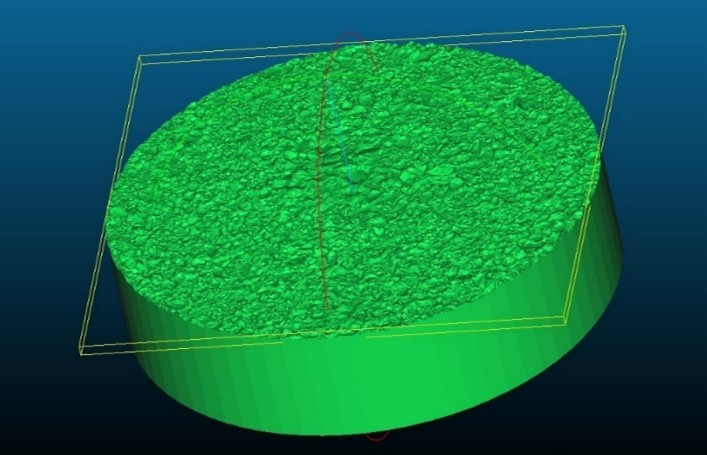
The research uses mathematical correlations between sand patch texture depth measurements, laser-based MPD and 3D handheld scanning to enable more accurate estimation of surface skid resistance. The results directly contribute to improving models for calculating safe vehicle stopping distances.
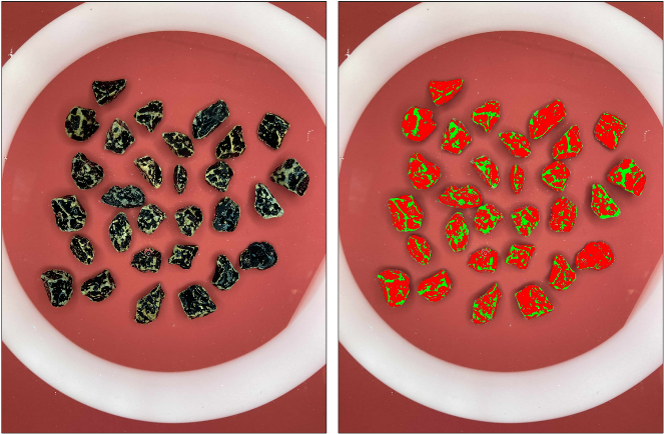
The project applies digital image processing, spectral analysis and artificial intelligence to objectively measure the degree of bitumen coating of aggregate particles. The automated method provides fast and reliable assessment of the moisture sensitivity and adhesion properties of asphalt mixtures.
The research investigates the viscous and elastic behaviour of modified and recycled bitumens (RA, PmB, GmB) using DSR and BBR rheometer measurements. The resulting rheological master curves provide a basis for designing pavement structures resistant to extreme weather conditions.
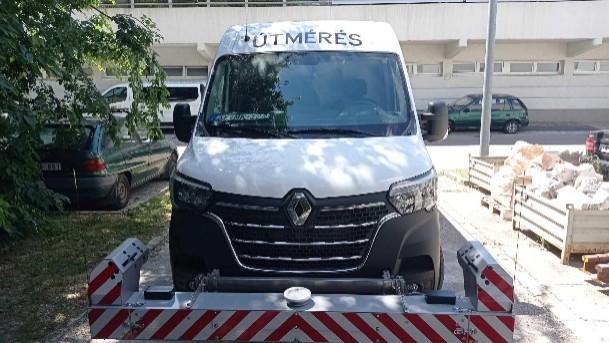
The project models the deterioration processes of road networks through specific analysis of asymmetric IRI values and pavement edge drop-offs. Integrating these data enables more accurate pavement deterioration functions to be determined for more effective maintenance strategies.
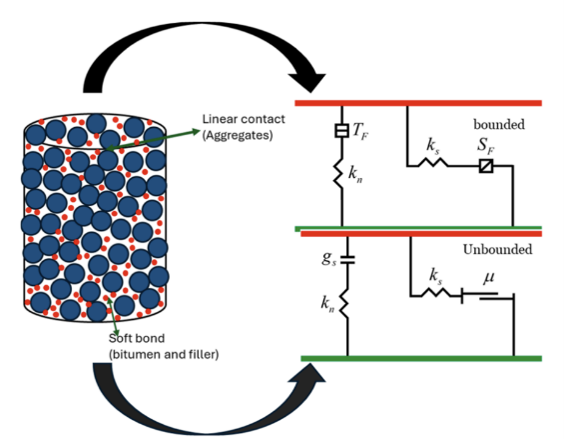
The research models the internal skeleton structure of asphalt using 3D-scanned real aggregate geometries and discrete element method (DEM) simulations. Numerical modelling makes it possible to predict the rutting and fatigue resistance of mixtures without the need to manufacture physical specimens.