Following last year’s record-breaking results, the general admissions process at Széchenyi István University concluded with outstanding results again this year: while the minimum score requirements rose further for most programs, nearly 4,700 applicants were admitted. This clearly demonstrates that the institution’s high-quality programs, designed to meet the needs of the labor market, are becoming increasingly popular among students seeking to continue their education.
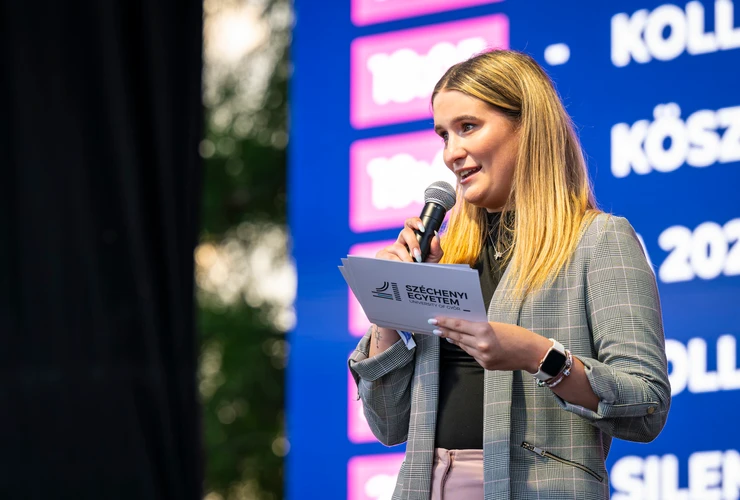
On July 23, after 8:00 p.m., students received notification of whether they had been admitted to any of the higher education institutions they had applied to, and at the same time, the admission cutoff scores were published on the felvi.hu website. Many of those who applied to Széchenyi István University gathered at the “Pont Ott Party” held at the Bridge Student and Faculty Club on the Győr campus to await the announcement of the results together.
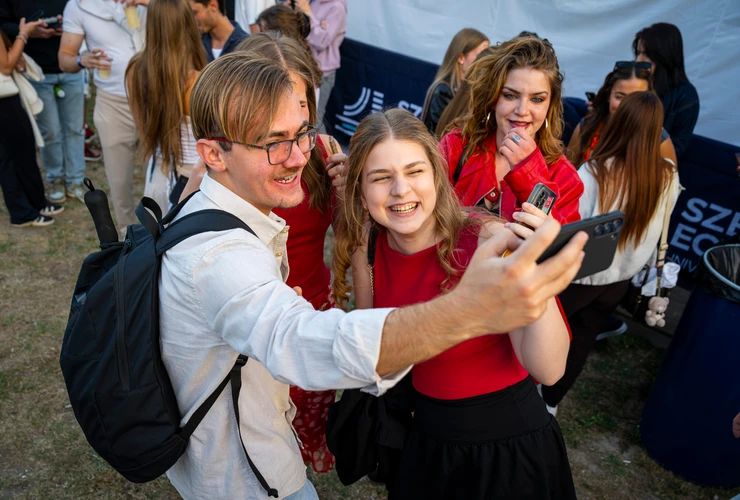
 After 8:00 p.m., text messages began arriving for the participants of the Pont Ott Parti event in Győr as well—many of them had reason to celebrate. (Photo: Máté Dudás)
For many other popular programs offering state scholarships, a score of more than 400 was required for admission. Examples include full-time programs in Business and Management (427) and Commerce and Marketing (424), as well as the part-time Law program (433).

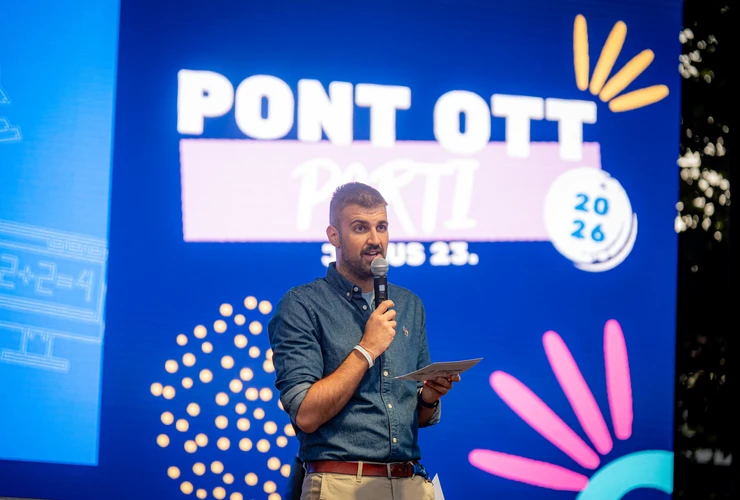
A large crowd gathered at the “Pont Ott” Party, held at the Széchenyi István University Bridge Student and Faculty Club, to await the announcement of the admission cutoff scores on the evening of July 23. (Photo: Máté Dudás)
The university also announced more than sixty English-language programs, which are extremely popular among international students: nearly 15,000 of them registered. As a result of the admissions process, 1,438 international students from 71 countries were admitted; of these, 1,227 will enroll in self-funded programs, 156 will begin their studies with support from the Stipendium Hungaricum or the Diaspora Higher Education Scholarship Program, while an additional 55 will join the university through short-term mobility programs. Thus, in the coming academic year, the university’s community will consist of international students from 88 countries.
“This year’s admissions results once again confirm that interest in the programs offered by Széchenyi István University remains strong. We are particularly pleased that the number of admitted students is approaching last year’s record, while approximately 100 more students receiving state scholarships than last year will be able to begin their studies at our institution. All of this demonstrates that we are able to maintain our broad range of programs while continuously improving their quality. Particularly encouraging are the impressive admission scores for economics programs, as well as the growing strength of our engineering, computer science, and social science programs. First-year students are arriving at a university that offers cutting-edge knowledge, an international environment, excellent infrastructure, and a strong network of corporate partnerships—all of which prepare them for successful professional careers. “We congratulate all of our admitted students and look forward to welcoming them to our community in September,” said Dr. Zsolt Kovács, Vice President for General and Educational Affairs at Széchenyi István University.

Among the faculties, the Audi Hungaria Faculty of Automotive Engineering saw higher admission cutoff scores than ever before, where first-year students can expect practice-oriented, industry-focused programs. Once again, the most popular program was the Hungarian-language bachelor’s program in automotive engineering, where the average score of admitted students exceeded 420. The faculty’s second most popular program was the bachelor’s degree in mechanical engineering, for which the minimum admission score rose by exactly 20 points. English-language programs continued to attract significant interest among both Hungarian and international students, as evidenced by the fact that the mechanical engineering program will also be offered in English this year.
This year, even more students than last year chose programs at the Faculty of Architecture, Civil Engineering, and Transportation Engineering. In addition to the increase in student enrollment, admission scores also rose—for example, in addition to the programs already mentioned, the undivided architecture program required 464 points for admission, while the English-language logistics engineering program required 380 points—which reflects the recognition of these programs that offer modern, practice-oriented knowledge. The admission thresholds for the architecture and civil engineering programs are outstanding even on a national level, while the bachelor’s program in logistics engineering leads in enrollment numbers. At the faculty, first-year students are welcomed by a friendly atmosphere, an active student life, and supportive faculty members who foster their development through personal attention and professional mentoring.
At the Faculty of Computer Science and Electrical Engineering, the Computer Engineering, Business Informatics, and Software Engineering programs continue to form the backbone of the student body. One of the most important new additions to the program offerings is the newly launched master’s program in Artificial Intelligence, which has generated exceptional interest among applicants. In addition to the fields of computer science, software development, and automation, traditional engineering programs (electrical engineering and mechatronics engineering) are also experiencing dynamic growth. It is telling that the average admission score for admitted students was 445 for the Computer Science (Programming) program, 442 for Computer Engineering, 423 for Electrical Engineering, and 417 for Mechatronics Engineering.
The number of students receiving state scholarships has risen at the Albert Kázmér Faculty in Mosonmagyaróvár, while international interest has also continued to grow. Among students admitted with state scholarships, enrollment has increased in agricultural bachelor’s, master’s, and integrated degree programs alike. Among the most popular programs are environmental engineering, agricultural engineering, food engineering, and animal husbandry engineering, as well as the ESG (Environmental, Social, and Governance Specialist) program, the agricultural engineering teacher training program, and the integrated agricultural engineering program. In several of the full-time bachelor’s programs—such as agricultural engineering, environmental engineering, and agricultural water management and environmental technology engineering—the average admission score is approaching 400.
At the Apáczai Csere János Faculty of Education, Humanities, and Social Sciences, the total number of admitted students rose by 20 percent, and the minimum admission score increased significantly in most programs. The highest cutoff scores were recorded by the distance-learning special education program at 438 points and the English-language international studies program at 435 points. In addition to the bachelor’s programs with stable enrollment, the distance-learning bachelor’s program in social work is also launching with promising enrollment numbers this year, as are all master’s programs. Interest in English-language programs is also growing among both Hungarian and international applicants.
At the Deák Ferenc Faculty of Political Science and Law, the positive trend of recent years continued: approximately 130 more applicants—a 33 percent increase—were admitted compared to last year. Contributing to this growth was the launch of two new master’s programs in September—Criminology and Digital Children’s Rights and Youth Protection—as well as an increase in the number of state-funded scholarship spots for the law program, for which a minimum score of 407 was required for admission to the full-time program.
The minimum admission scores have risen significantly for all programs at the Faculty of Health and Sports Sciences. The largest increase in the number of admitted students was seen in the full-time undergraduate programs in the health sciences, specifically in the nursing, midwifery, and health care administration programs. There continues to be significant oversubscription for the master’s program in health psychology, which will also be offered in English. New additions include the master’s program in sports coaching (covering 12 sports) and, as the next step in the faculty’s internationalization efforts, two additional English-language programs: the master’s programs in health management and nutritional science.
At the Gyula Kautz Faculty of Economics, admission score thresholds rose significantly in several programs, confirming the success of the faculty’s goals related to international accreditation. The English-language Bachelor’s program in International Business, launched two years ago, was exceptionally popular. The average admission score for accepted students is close to or exceeds 450 points in the programs in Business and Management, Commerce and Marketing, as well as the English-language programs in International Business and Tourism and Hospitality. The master’s programs offered by the faculty, which provide high-quality education, remain popular.
The number of admitted students at the Faculty of Arts increased by nearly four percent. First-year students are entering the design programs with outstanding scores—the minimum admission scores for the bachelor’s programs approached 400—and the music entrance exams show that exceptionally talented young people are beginning their studies. Starting in September, a one-year master’s program in music performance—the only one of its kind in the country—will also launch in collaboration with the Győr Philharmonic Orchestra.