Railway Tracks, Rolling Stock and Energy Research Group
INTRODUCTION TO THE RESEARCH GROUP
The SZE-RAIL Research Group brings together research into the structural subsystems of the railway system – the track and its structures, power supply, signalling systems, traffic control and rolling stock. Established in 2022 and accredited in 2023, the group brings together lecturers, researchers, PhD students and undergraduates specialising in civil, mechanical, electrical, transport and vehicle engineering, thereby examining issues relating to rail transport – from track structure to rolling stock – from a unified perspective.
The research group’s areas of focus include the reinforcement of sub-structures and superstructures with crushed stone ballast using specialised structural solutions – geosynthetics, concrete mats and base slabs – as well as the classification and fragmentation testing of ballast materials, experimental and numerical analysis of the load-bearing capacity of reinforced concrete sleepers and embedded rail systems, material testing of rails and rail joints, and the development of track structure materials – modified asphalt mixtures, fibre-reinforced concrete, and 3D-printed composites.
Another important area of research is the energy efficiency of electric traction: investigating energy losses resulting from drivers’ driving styles and track conditions, making better use of regenerative braking energy, and developing an in-vehicle system for measuring acceleration and energy consumption, along with the associated evaluation algorithm. In addition, the group is refining models of track geometry deterioration through time-series and distribution-based analysis of long-term measurement data sets, and is applying digital image correlation, artificial intelligence and unmanned aerial vehicles to assess the condition of structures and vehicles. The research group aims to contribute, through its scientific findings, to the development of safer, more energy- and cost-efficient, and environmentally friendly fixed-track transport systems. We carry out our work in collaboration with industry partners – including experts from BKV Zrt., Colas Északkő Kft., and others – as well as through international cooperation with researchers in Dresden, Berlin, Dnipro, Belgrade and Niš.
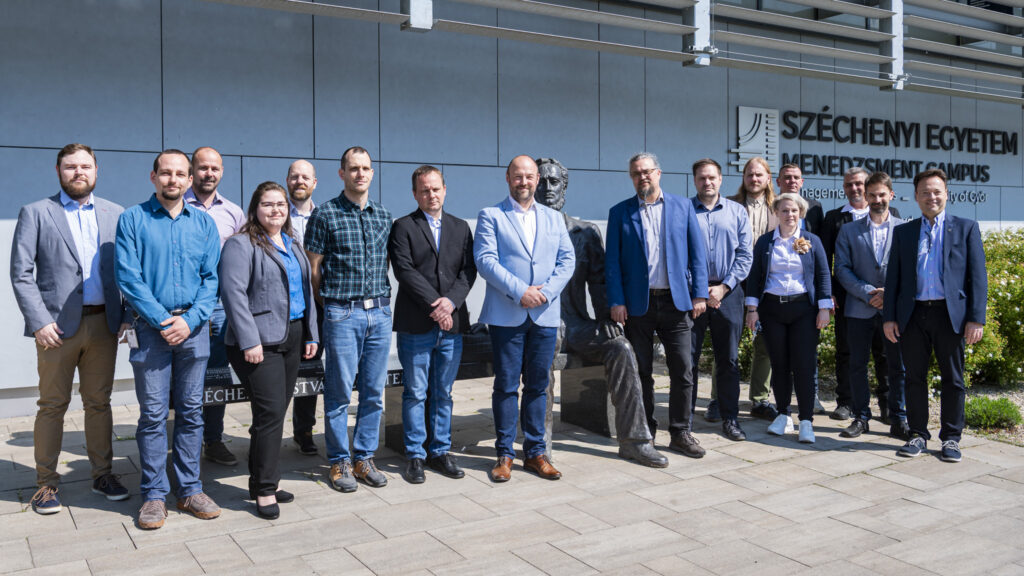
Head and members of the research group
Szabolcs Fischer (Dr.)
Full Professor
Research Group Leader
Department of Transport Infrastructure and Water Resources Engineering
Ádám Titrik (Dr.)
Department of Road and Rail Vehicles
Ágnes Pálfiné Böröcz
Materials Testing Laboratory
András Brautigam (Dr.)
Budapest Transport Privately Held Corporation
András Lajos Nagy (Dr.)
Department of Vehicle Manufacturing and Technology
András Pollák
Department of Architecture and Building Construction
Attila Nagy
Department of Applied Mechanics
Attila Németh (Dr.)
Department of Transport Infrastructure and Water Resources Engineering
Balázs Eller (Dr.)
Rail-Road Plan Kft.
Bálint Molnár
Department of Logistics and Forwarding
Bence Hermán
Department of Vehicle Manufacturing and Technology
Brigitta Fruzsina Szívós
Department of Vehicle Manufacturing and Technology
Dániel Harrach (Dr.)
Department of Structural and Geotechnical Engineering
Dániel Kocsis
Department of Vehicle Manufacturing and Technology
Dániel László Hegedűs
Department of Architecture and Building Construction
Dóra Horváth-Borsné Harangozó
Research Group Founding Member, Department of Materials Engineering and Machine Design
Erika Huschek-Juhász
RailCert Hungary Kft.
Gábor Kovács (Dr.)
Department of Criminology and Forensic Sciences
Gergő Dávid Monek(Dr.)
Department of Automation and Robotics
Gusztáv Baranyai
Department of Structural and Geotechnical Engineering
György Szabó
Department of Vehicle Manufacturing and Technology
Hanna Csótár
Department of Vehicle Manufacturing and Technology
Imre Fekete
Department of Materials Engineering and Machine Design
János Hollósi
Vehicle Industry Research Center
Katalin Kozma
Department of Applied Sustainability
Klaudia Madarász
Department of Transport Infrastructure and Water Resources Engineering
Kornél László
Department of Vehicle Manufacturing and Technology
László Ézsiás
Colas Északkő Kft., Department of Transport Infrastructure and Water Resources Engineering
László Pálfi
Department of Vehicle Manufacturing and Technology
Márton Gábor Légrádi
Department of Vehicle Manufacturing and Technology
Miklós Kuczmann(Dr.)
Department of Automation and Robotics
Nikoletta Légmán
Department of Materials Engineering and Machine Design
Norbert Szántó
Department of Automation and Robotics
Richárd Nagy (Dr.)
Department of Transport Infrastructure and Water Resources Engineering
Szabolcs Szalai (Dr.)
Deputy Head of the Research Group, Research Group Founding Member, Department of Vehicle Manufacturing and Technology
Szürke Szabolcs Kocsis (Dr.)
Deputy Head of the Research Group, Researc Group Founding Member, Department of Road and Rail Vehicles
Viktor Zoltán Nagy (Dr.)
Department of Vehicle Manufacturing and Technology, SZESIM Vehicle and Transport Simulation Laboratory
Vivien Nemes
Department of Vehicle Manufacturing and Technology
Vivien Révész-Jóvér
Ministry of Transport and Public Investments
Zoltán Major (Dr.)
Department of Transport Infrastructure and Water Resources Engineering
Ongoing research topics
Energy efficiency of electric traction: development of an on-board acceleration and energy consumption measurement system; investigation of the impact of driving style and track conditions on energy loss; quantitative analysis of acceleration and regenerative braking energy on multiple units and locomotives.
Reinforcement of sub-base and surface course layers on a crushed stone sub-base using concrete slabs, geosynthetics and base course; laboratory tests.
Subgrade condition and maintenance strategy: ballast fragmentation (modified BBI – Ballast Breakage Index), settlement behaviour under dynamic loading, the detection of support deficiencies (voids) through rail deflection measurements, and the life-cycle cost analysis of wide sleepers and universal side compaction.
Refinement of track geometry deterioration models through the statistical analysis of long-term track measurement data sets on mainline and tramway tracks; data-driven, life-cycle-based maintenance decision support for tramway variants.
Mathematical modelling of superstructure-substructure systems: the effect of the model domain size and boundary conditions on the calculation results; hybrid analytical-numerical solutions.
Stiffness and temperature transitions: mitigation of additional dynamic effects and track deterioration occurring at track-bridge stiffness transitions, and determination of rail expansion movements at tunnel portals in the event of significant temperature changes.
Material testing of rails and rail joints: heat-affected zones of aluminothermic welds; field assessment of austenitic filler metal surfacing; and welded joints between Hadfield and high-strength steel plates and rails.
Mechanics of rail-wheel contact: numerical determination of Hertz’s contact radii.
3D-printed polymer structures in track construction and measurement technology: PLA- and ABS-reinforced concrete elements, load-bearing capacity of resin-printed components, tooling using FDM and DLP technologies.